Built for the fireground.
Made for the people who work it.
Software for the fire service, written by a working captain and paramedic who has lived the problems it solves.
Different seats. Different jobs.
Some run on the fireground, some at the kitchen table with your crew, one in the chair across from the promotion panel. Each one was built because the thing that was needed didn't exist.
Incident Command
A tactical worksheet and accountability board for the officer running the incident. Unit tracking, assignments, PAR timers, and a scene record that survives the call - on a tablet, in the front seat, with or without a signal.
Interview Prep
A practice panel in your pocket. Answer real promotional questions out loud, get scored against a published rubric, and find out which competencies you have no story to prove - before the panel finds out for you.
ReadyLine Training
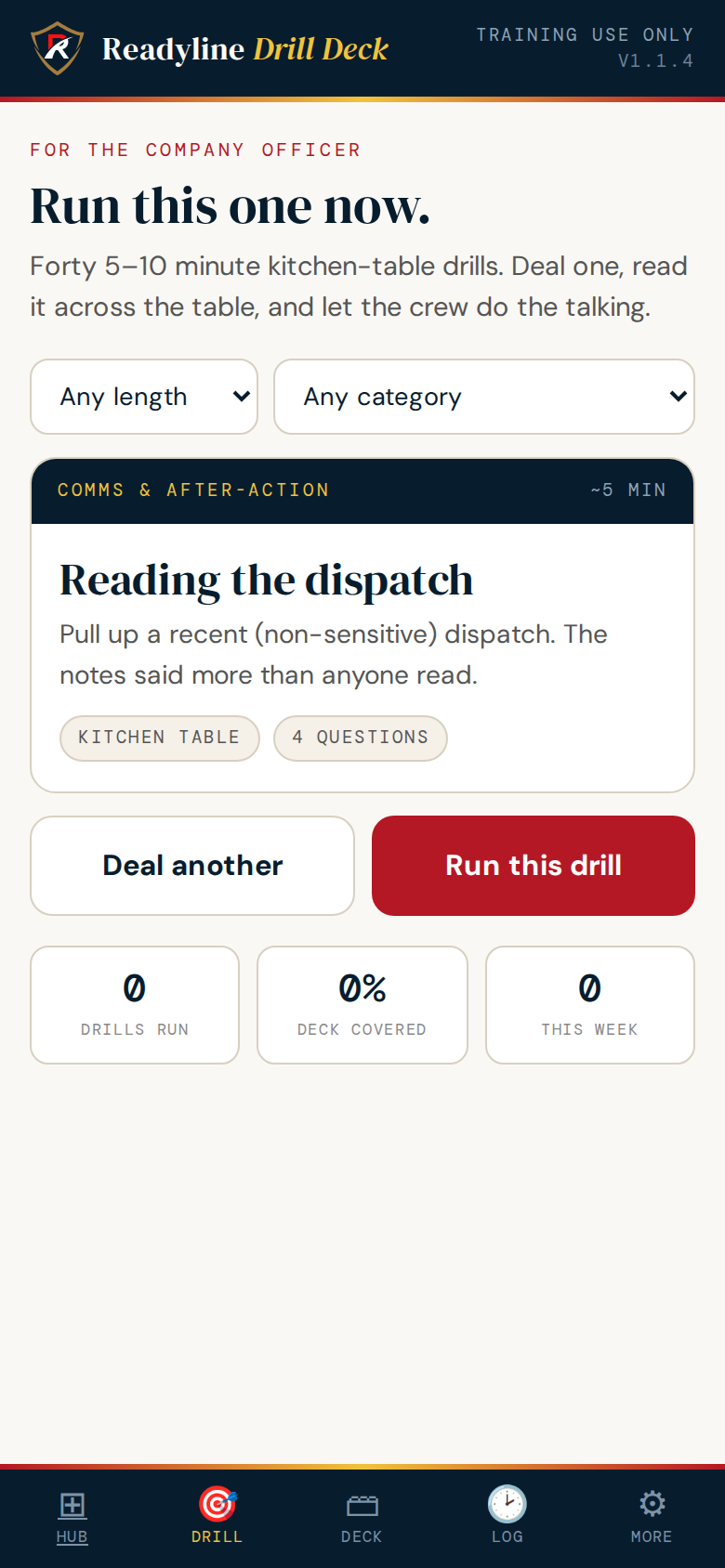
Four solo trainers in one app: run the mayday call you hope to never make, give your first-arriving size-up and progress (CAN) reports out loud, and deal kitchen-table drills for your crew. All reps. No scoring. Everything on your device.
ReadyLine Apparatus
Turn the apparatus you ride into a study tool. Photograph each compartment, place it right on a photo of the apparatus, and tag what rides inside - then drill yourself until you know where every tool lives. All on your device, nothing uploaded.
Built from real experience in the fire service.
Every ReadyLine tool starts from the seat - from what an officer actually needs, in the moment they need it, whether that's a 0300 basement fire or the two minutes that decide a call.
Each one is built on real fire-service experience, shaped by real use, and refined until it holds up. The goal is simple: tools that genuinely help firefighters do the job.
Incident Command
The tactical worksheet, rebuilt for the officer who is actually running the call.
A grease pencil and a clipboard can't tell you who's been inside for eighteen minutes.
Accountability on a working fire is a memory test that nobody should be taking. Units arrive, get assigned, move, get reassigned. Somebody is supposed to be tracking all of it while also running the incident, working the radio, and thinking three steps ahead.
Incident Command handles the tracking so the officer can do the thinking.
Place units on the fireground by division, group, and assignment. Drag to reassign. The board is the incident.
Know who is where, and how long they've been there. PAR timers call out before the clock becomes a problem.
Structure, MVA, medical, hazmat, rescue. The board reshapes to the call type instead of fighting it.
Capture conditions, actions, needs as they come in - typed or spoken - without losing the board.
Runs entirely on the device. No coverage, no cloud, nothing to log into at 0300.
Export the full scene timeline for the post-incident review, the report, or the training officer.
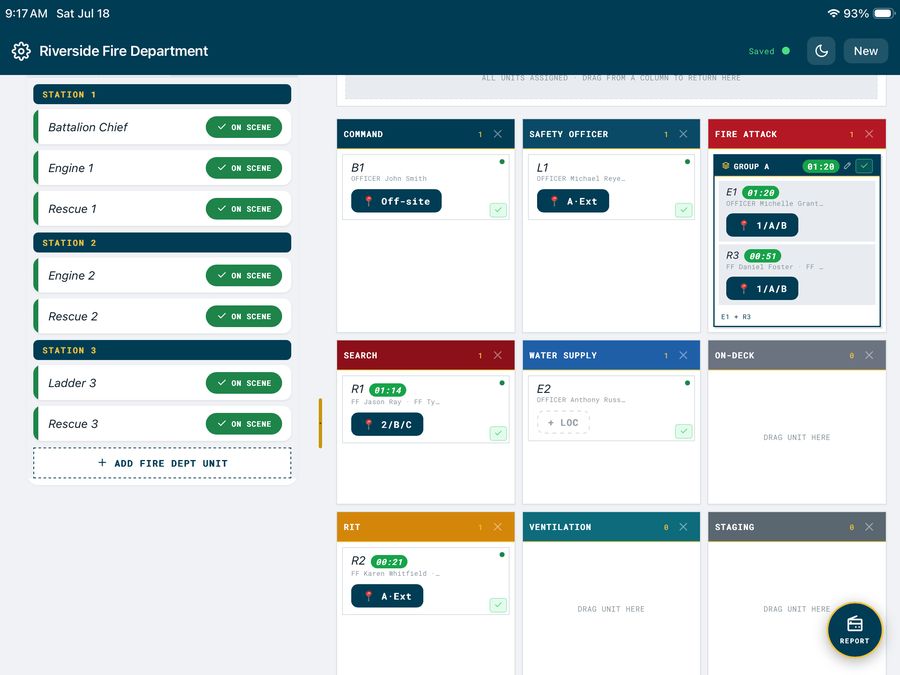
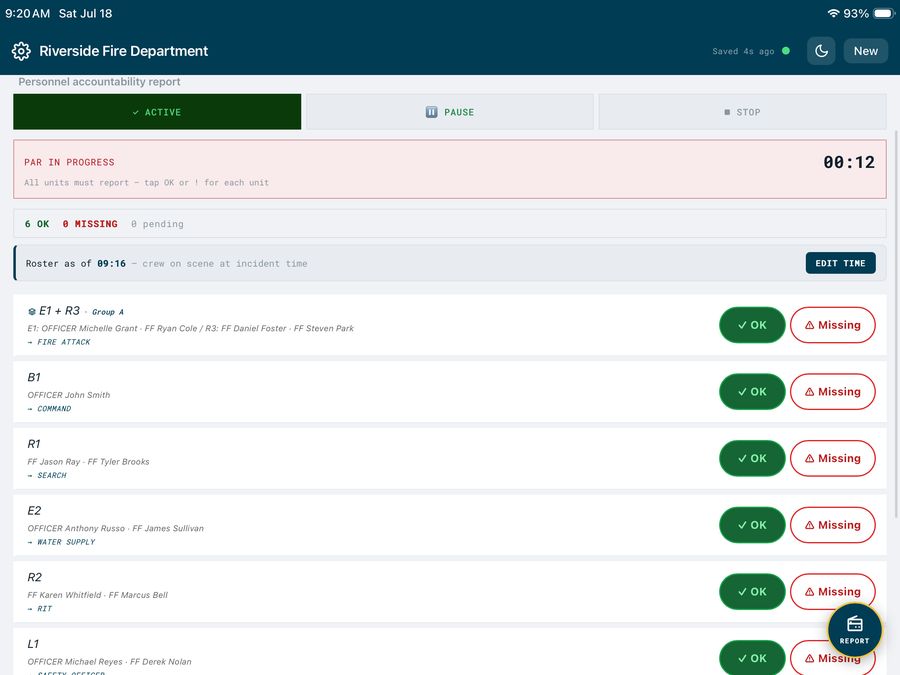
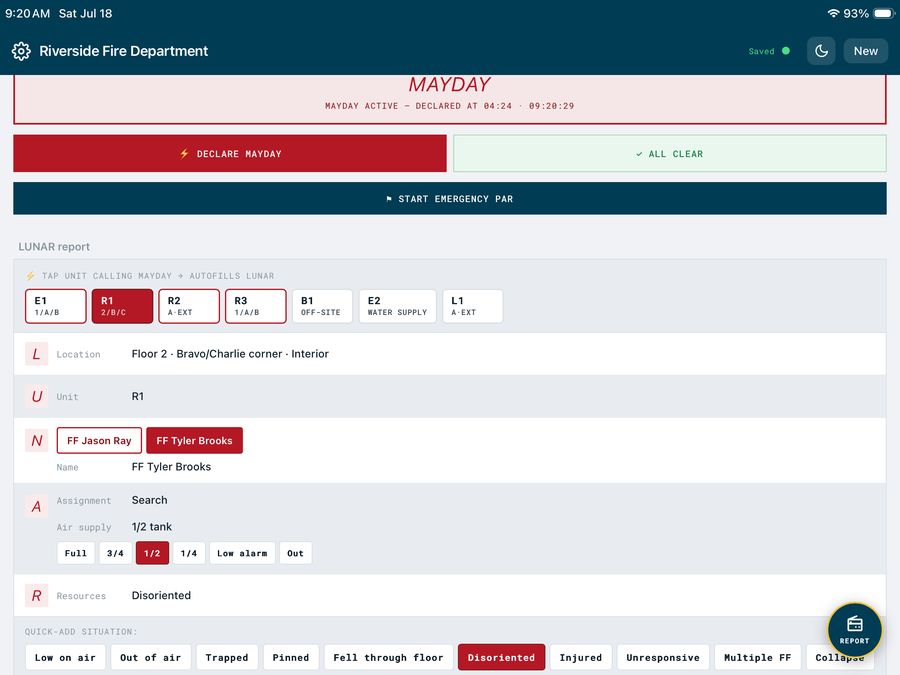
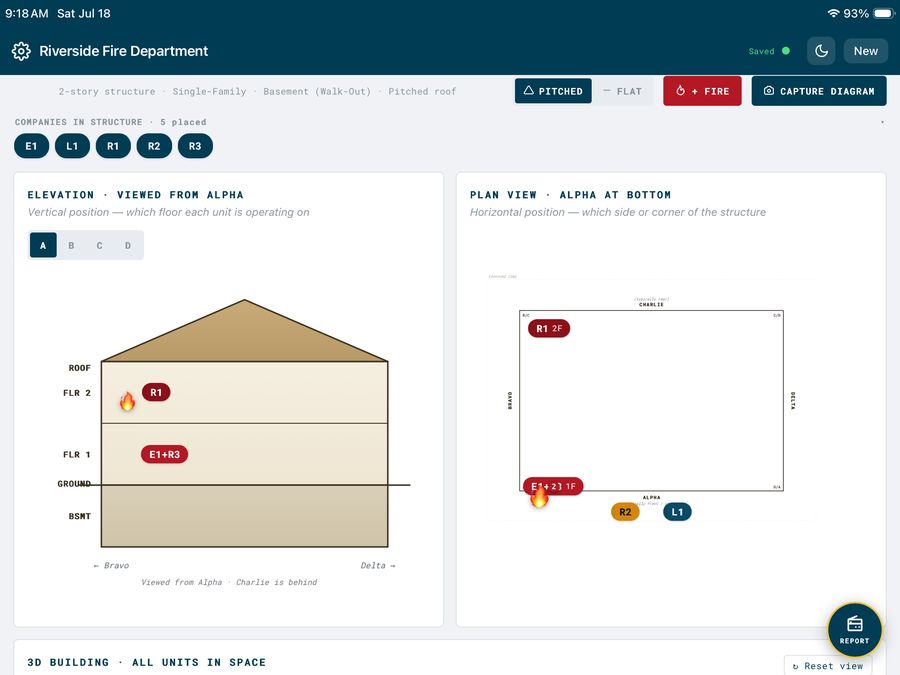
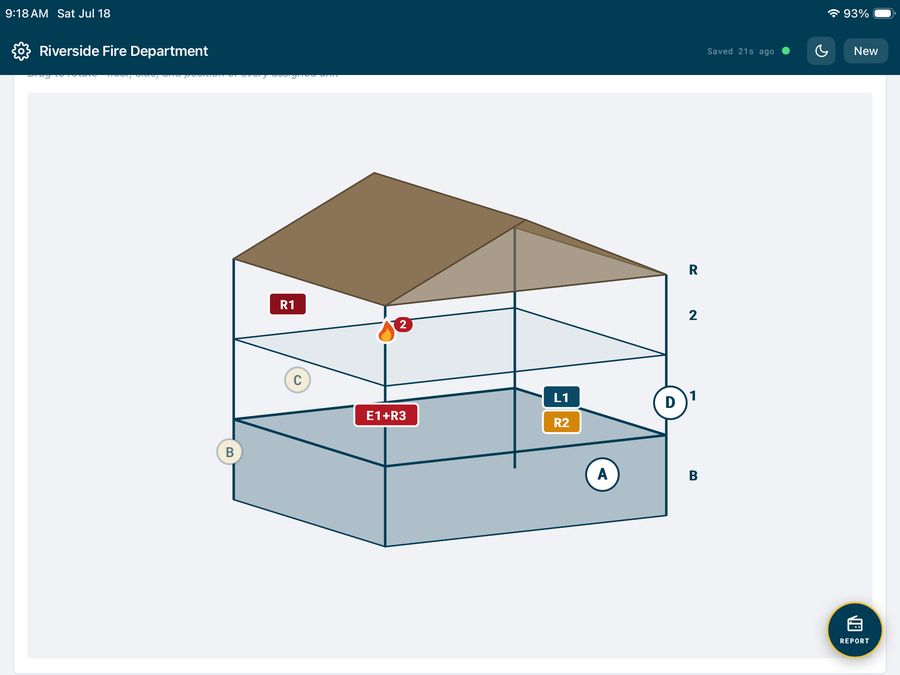
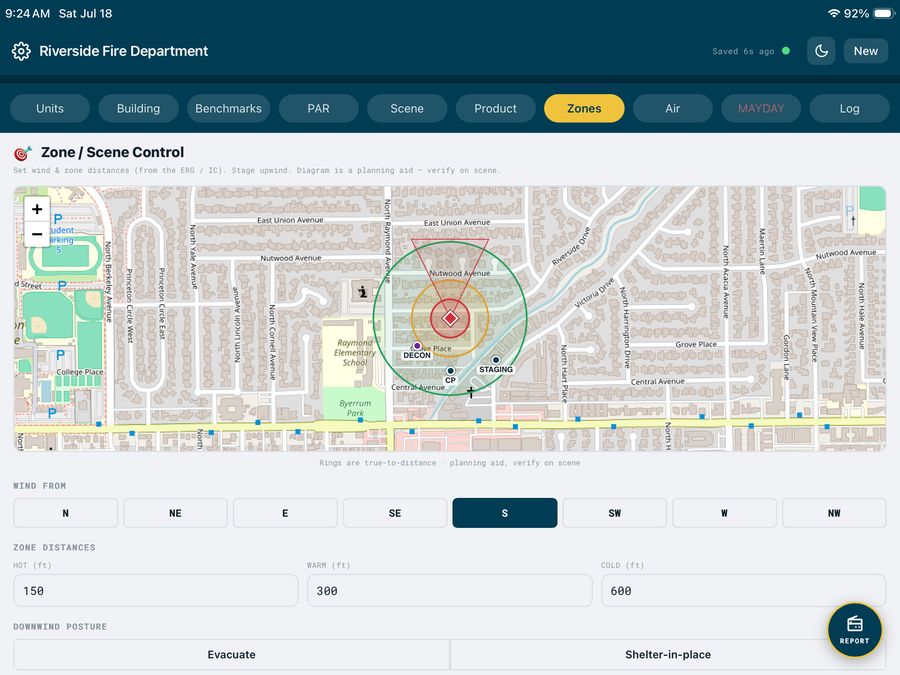
In field testing. Incident Command is in active use and iteration with a Michigan department. It is not yet generally available. If you run a department and want to see it, get in touch - early departments shape what it becomes.
Incident Command is a decision-support and accountability tool. It does not replace your department's official accountability system, your records management system, or your standard operating guidelines. It supports the officer; it does not substitute for one.
Fire Officer
Interview Prep
A practice oral board in your pocket. Answer out loud. Get graded like a panel grades.
Now on Google Play and the App Store. A flat $14.99. No subscription, no account.
You can read about answering questions. You can't read your way into answering them well.
The oral board is spoken, timed, and unforgiving. Most candidates prepare by reading a book, thinking about their stories in the truck, and then hearing themselves out loud for the first time in the room that counts.
Promotional coaching works - and costs $500 to $2,000. This is the version you can afford, and use at the kitchen table at 2 a.m.
Key up like a radio and answer. The app listens, times you, and transcribes what you say using your browser's built-in speech feature.
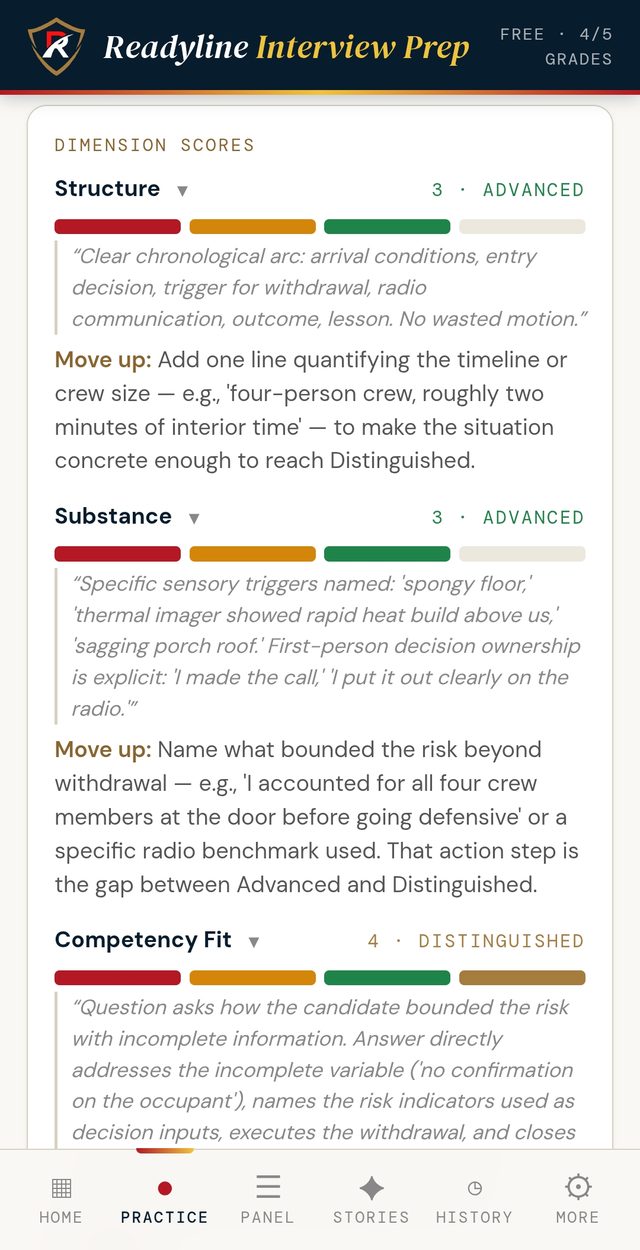
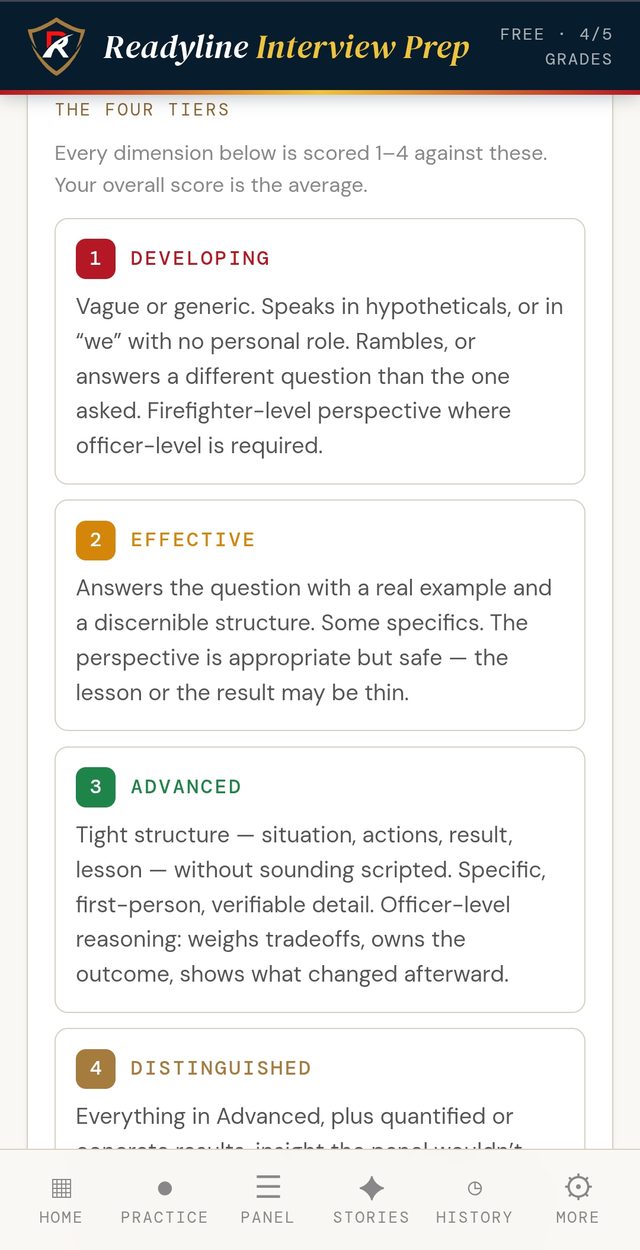
Four tiers, five dimensions. No black box - the standard is printed in the app, so you can see exactly what moves you up a tier.
Pace, filler words, and length against the target window. The things a panel notices and nobody tells you.
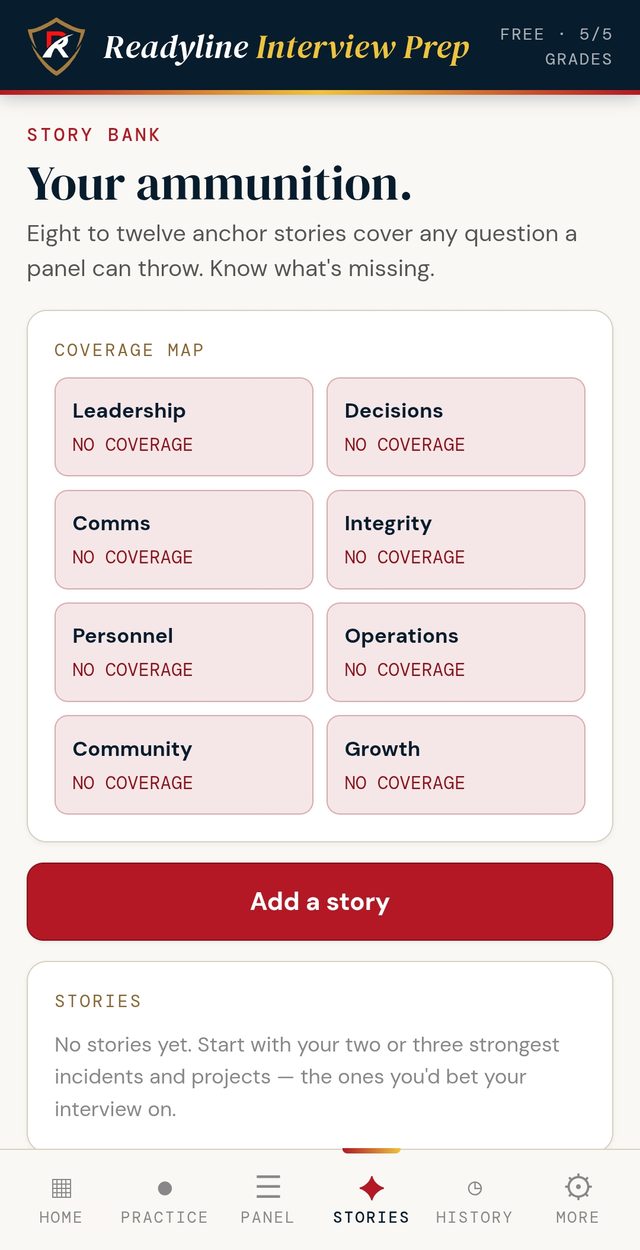
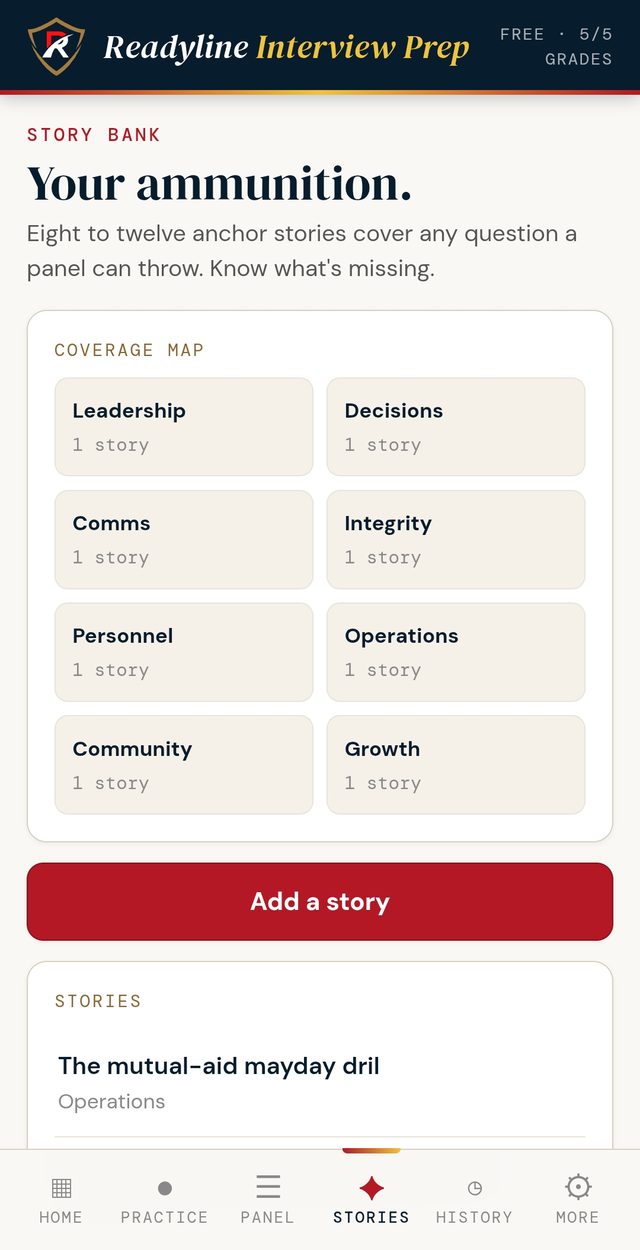
The app maps your anchor stories to competencies and shows you which ones you have nothing to prove. That screen is the point.
Five to seven questions, timed, sequential, no coaching until the scorecard. Exactly like the real chair.
Sharp panels press. So does this. Answer the follow-up while your first answer is still on the table.
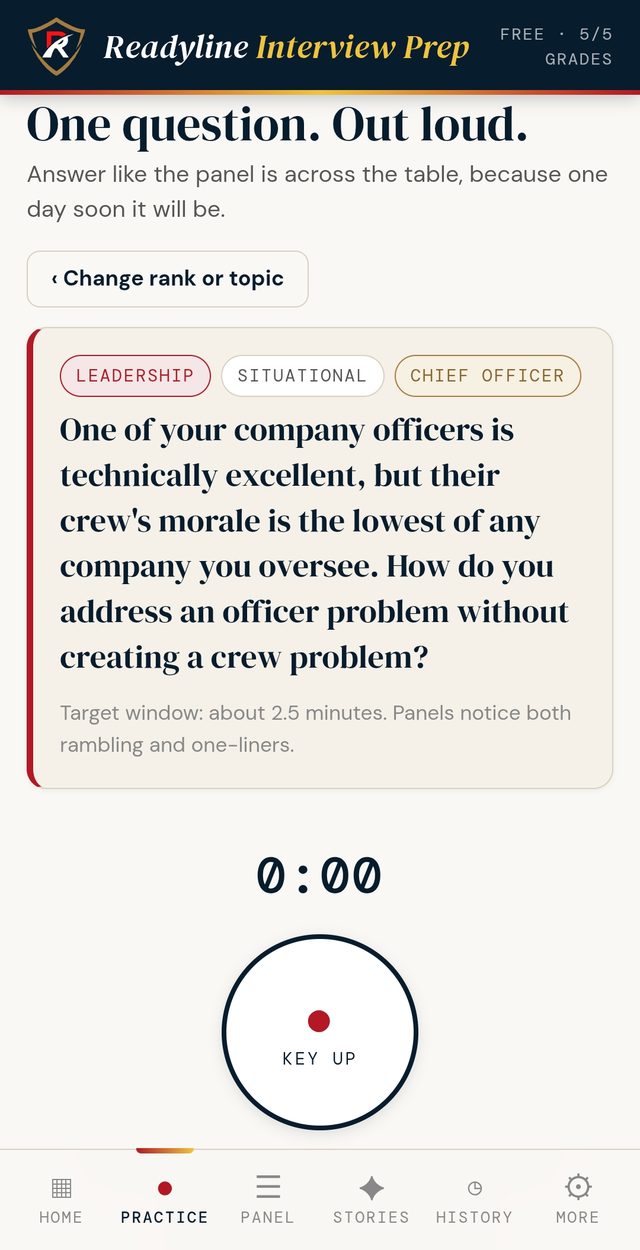
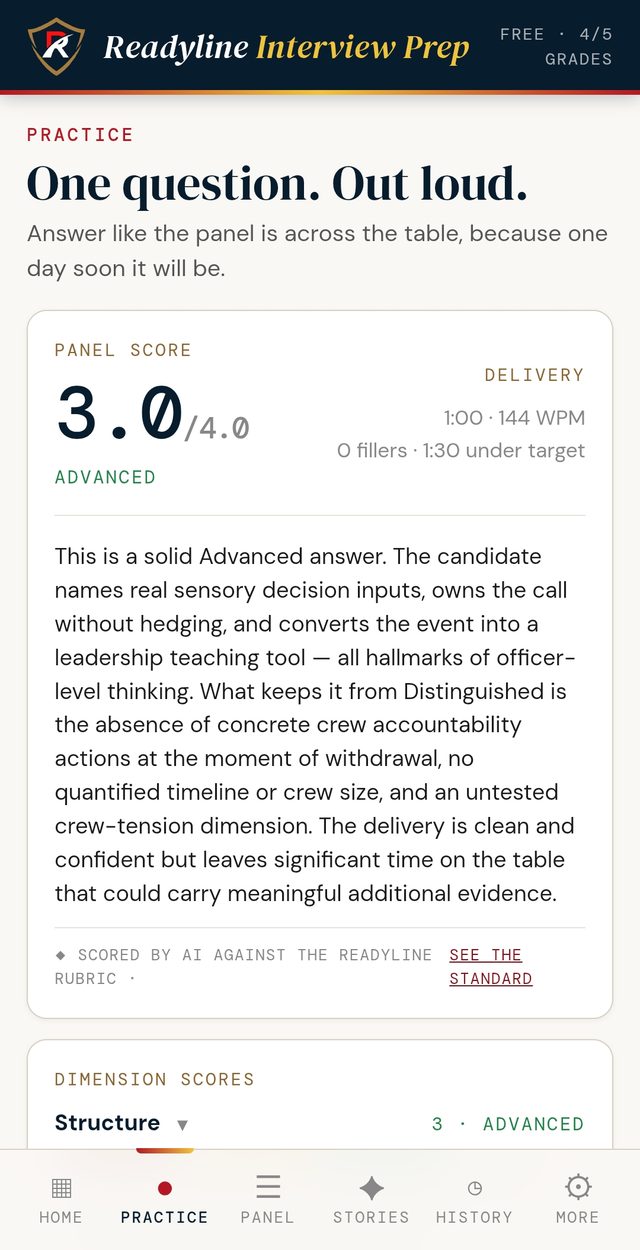
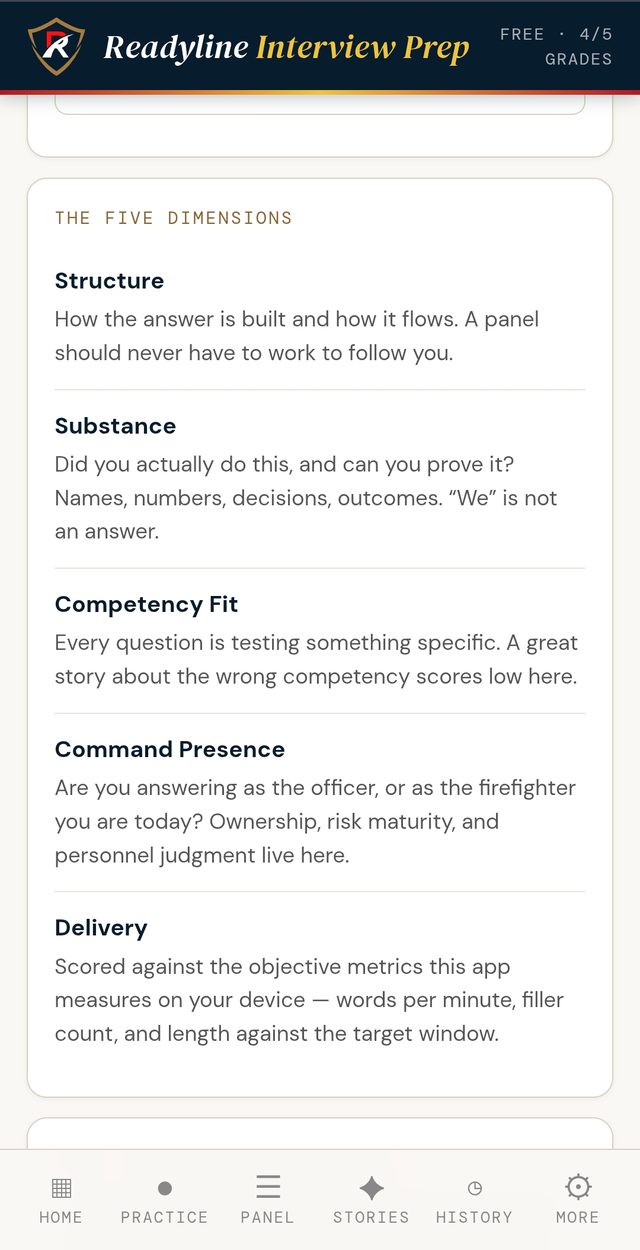
Questions and competencies are built on the fire officer duty areas of NFPA 1021 (now consolidated into NFPA 1020) and published officer-development material. The framework is generic and national - it does not mirror any single department's process, and no endorsement by NFPA is implied.
Your scores are practice feedback from an AI assessor, not an official evaluation, and no promotional outcome is guaranteed. Speech-to-text uses your browser's built-in speech feature, which may send your speech audio to your browser or device maker (for example, Google or Apple) to transcribe it; ReadyLine never receives your audio, and only the text of your answer is sent for scoring. Any playback recording stays in your device's memory and is discarded when you leave the answer screen.
Testing this cycle?
Interview Prep is live on Google Play and the App Store. A flat $14.99. Unlimited graded practice, no subscription, no account - less than one hour with a coach.
ReadyLine
Training
Four solo trainers in one app - the mayday call, the size-up, the CAN report, and kitchen-table drills. All reps. No scoring.
Now on Google Play and the App Store - $4.99, one time. No subscription. No account. New trainers added in free updates.
The skills that matter most get practiced least.
Nobody reps the mayday call. Nobody practices the size-up out loud before it counts. Interior crews wing the CAN report on the radio. And good crews want to drill, but building one takes prep time officers don't have. ReadyLine Training puts all four in your pocket - solo reps, on your own time, with nobody watching.
Run a mayday from a realistic scenario: key up, give the call out loud, and hear your own voice back. LUNAR, UCAN, Who-What-Where, or your department's own format.
Forty-eight kitchen-table knowledge drills across eight categories. Deal one, talk it out as a crew, and look the answer up in your own SOG - never a generic answer key.
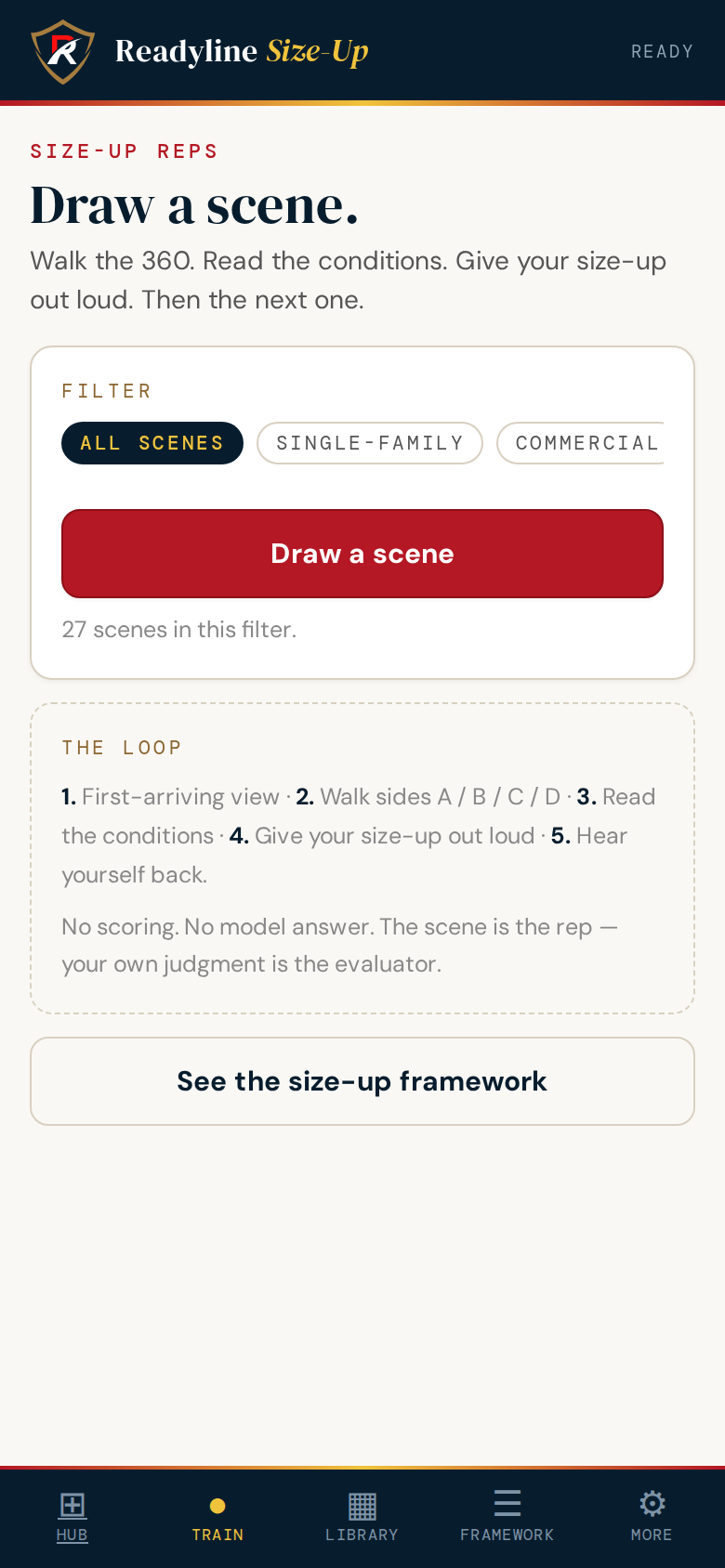
Draw a scene, walk the 360, and give your size-up out loud - then hear yourself back, the way the second-due officer would. As many reps as you want, alone, before it counts.
Conditions, actions, needs - the progress report every interior crew owes Command, in one clean breath. Get a scenario, key up, and give your CAN out loud - then hear it back. Rep it until it's reflex on the radio, not a scramble.
No AI judging a survival call or your size-up. The reps are yours; the standard comes from your department and your training.
The trainers run fully offline after install - basement firehouse, rural district, doesn't matter. Everything you do stays on your device; Size-Up's photo scenes download the first time you open them, then work offline too.
$4.99 once on Google Play. No subscription, no account, no upsells inside. New trainers and content arrive as free updates.
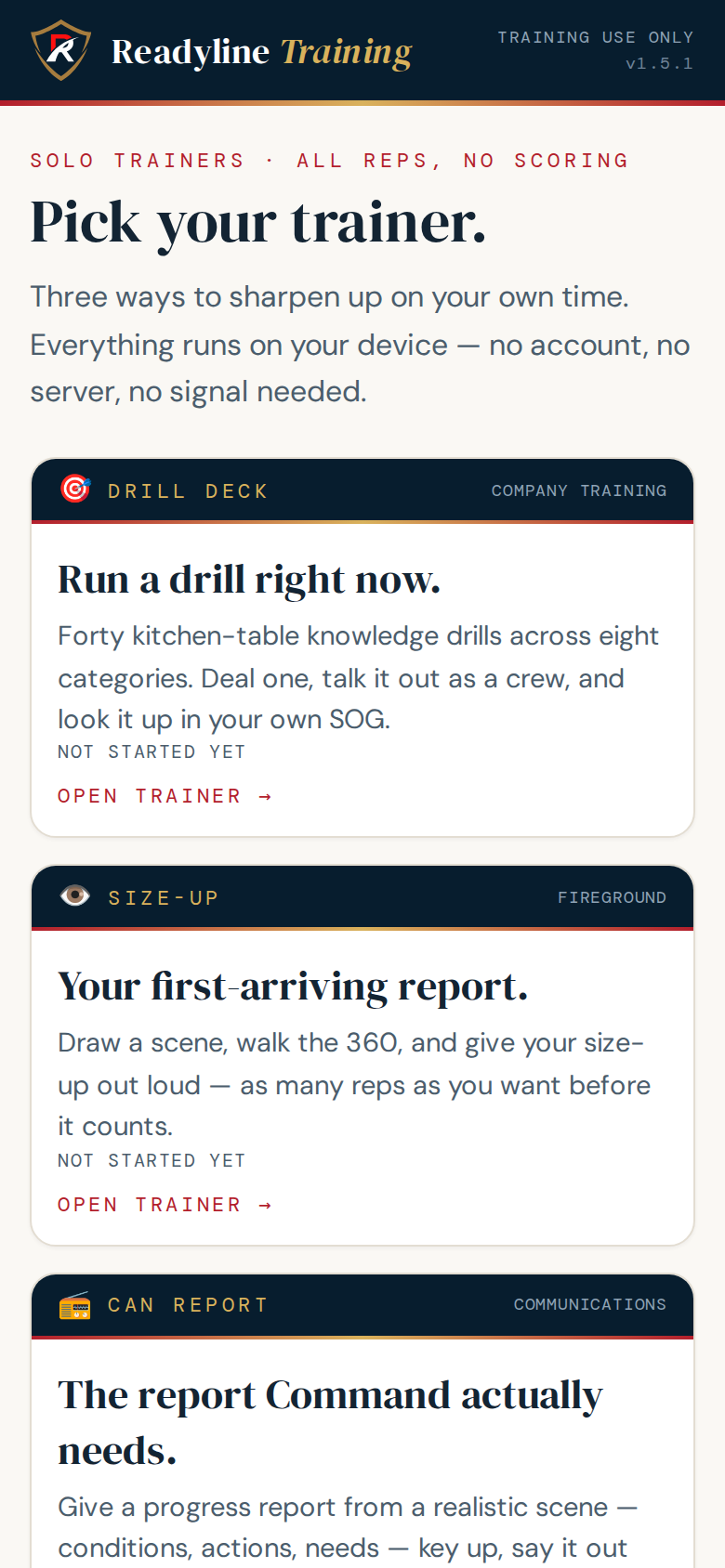
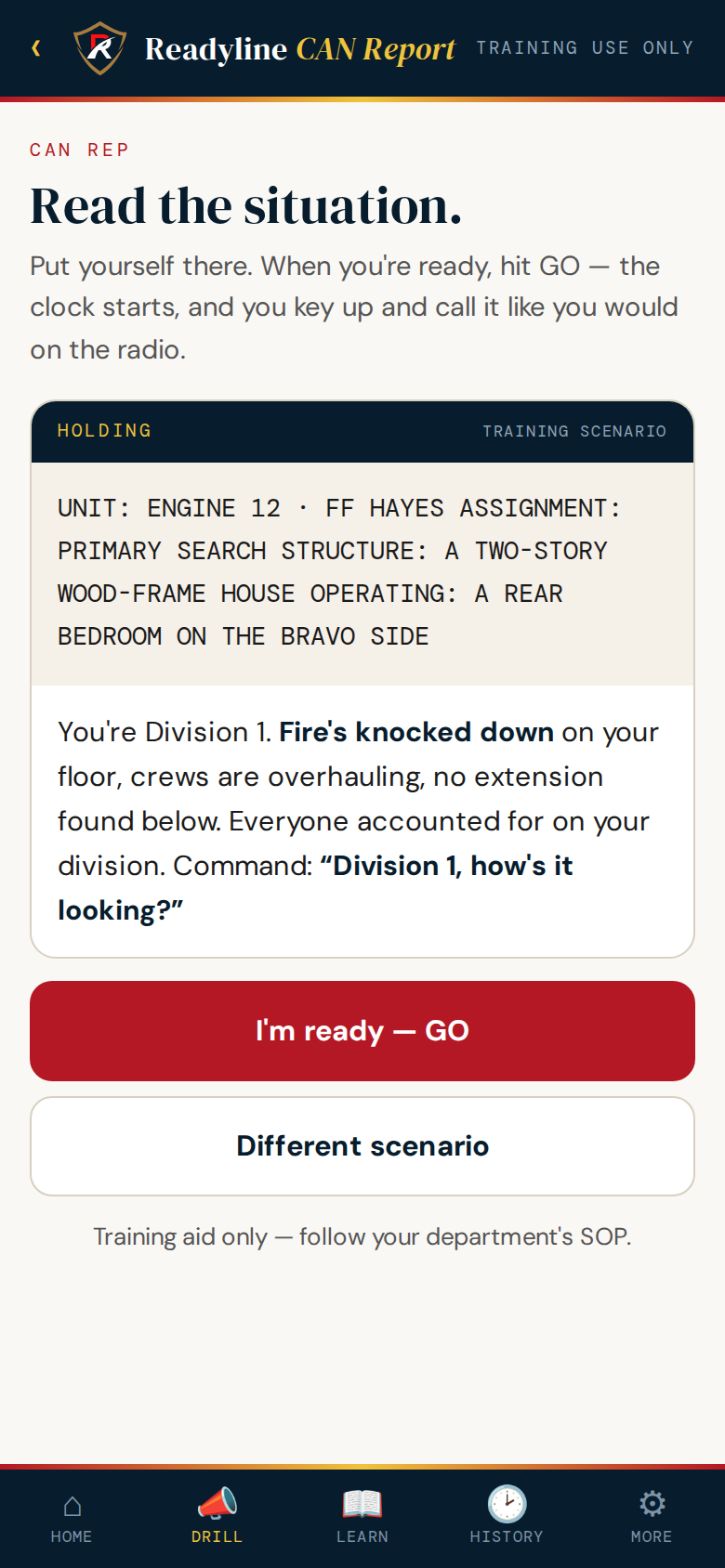
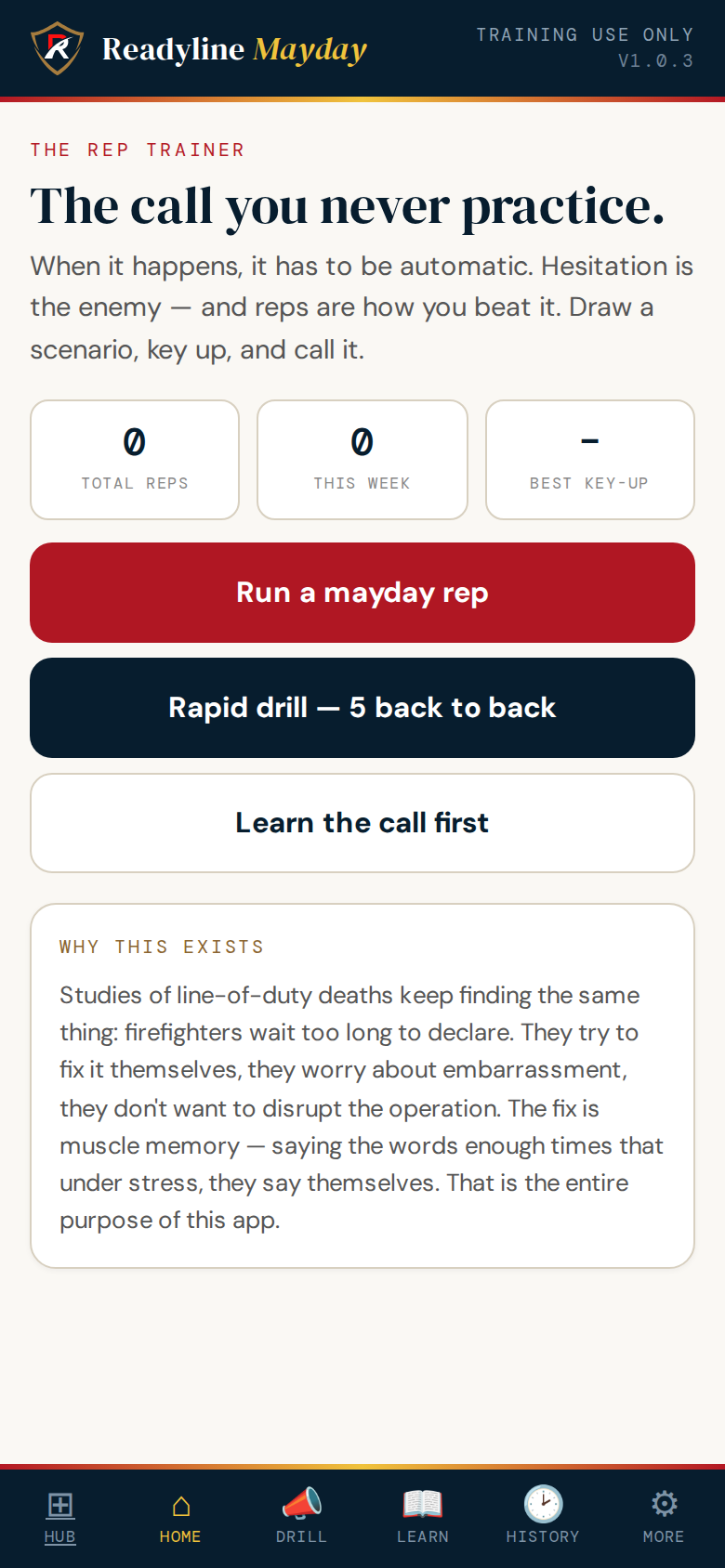
Everything stays on your device.
No server, no account, no tracking. Your reps, your history, and your custom drills live on your phone and nowhere else. In the voice trainers, any recording is held only in memory for playback and discarded when you leave the screen - never saved, never sent to us. Turning your speech into text uses your browser's built-in speech feature, which may send the audio to your browser or device maker to transcribe it.
ReadyLine
Apparatus
Every compartment. Every tool. Committed to memory.
Now on Google Play and the App Store - $4.99, one time. It runs entirely on your device - nothing to upload, nothing to sign into.
When seconds count, hesitation costs.
The best crews don't think about where the tool is - they just grab it. That kind of recall isn't a gift, it's reps. But the apparatus you ride is the one thing you can't take home to study, so those reps are hard to come by.
ReadyLine Apparatus turns the apparatus into something you can drill on your own time - visually, compartment by compartment, the way you actually learn a rig.
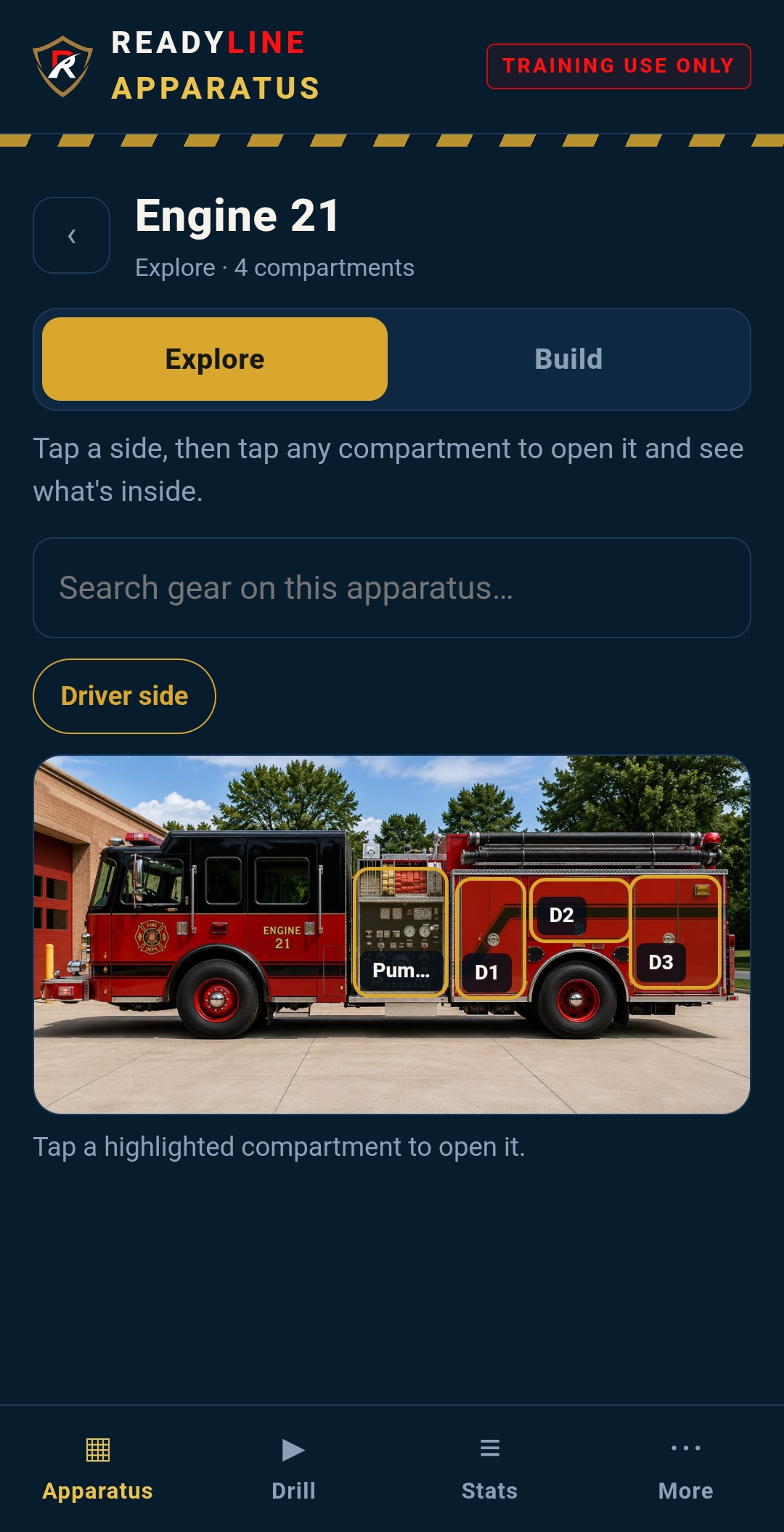
Photograph each side square-on - driver, officer, rear, front, whatever sides you run.
Tap the photo where each compartment lives and drop a box on it. Now the apparatus is mapped exactly the way you see it on the apron.
Open each compartment and add its contents from a built-in fireground equipment list - or your own gear, your own names. Multiple photos, notes, quantities, training links.
Get prompted for a tool and tap the compartment it's in. Track what you're getting right and where you're weak, and run reps until you know the whole apparatus.
Build and drill your own apparatus, or open a read-only set your department sends out - so every member studies the same apparatus the same way.
No coverage, no cloud, no login. The whole thing runs on the device, on the apron or in the bay.
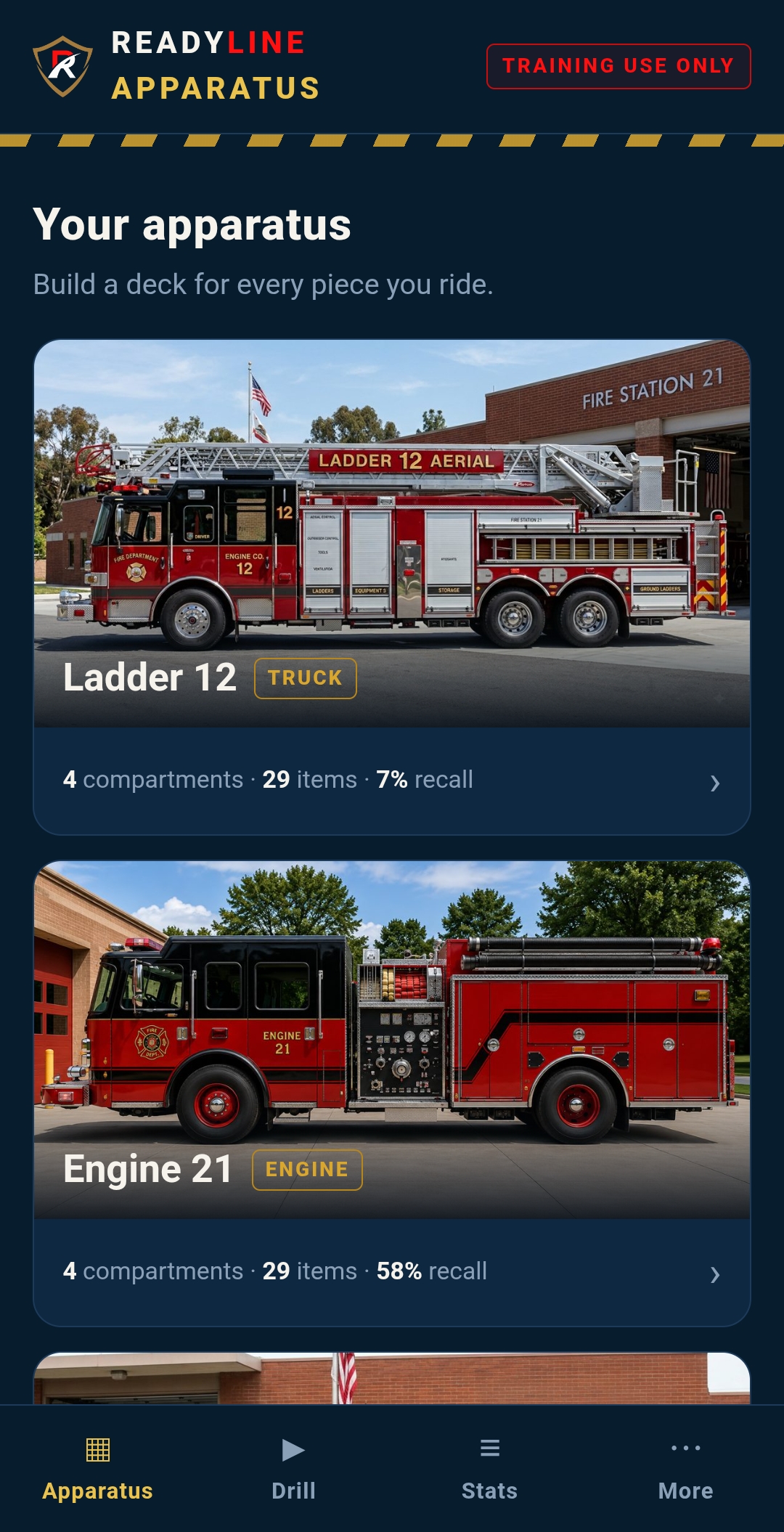
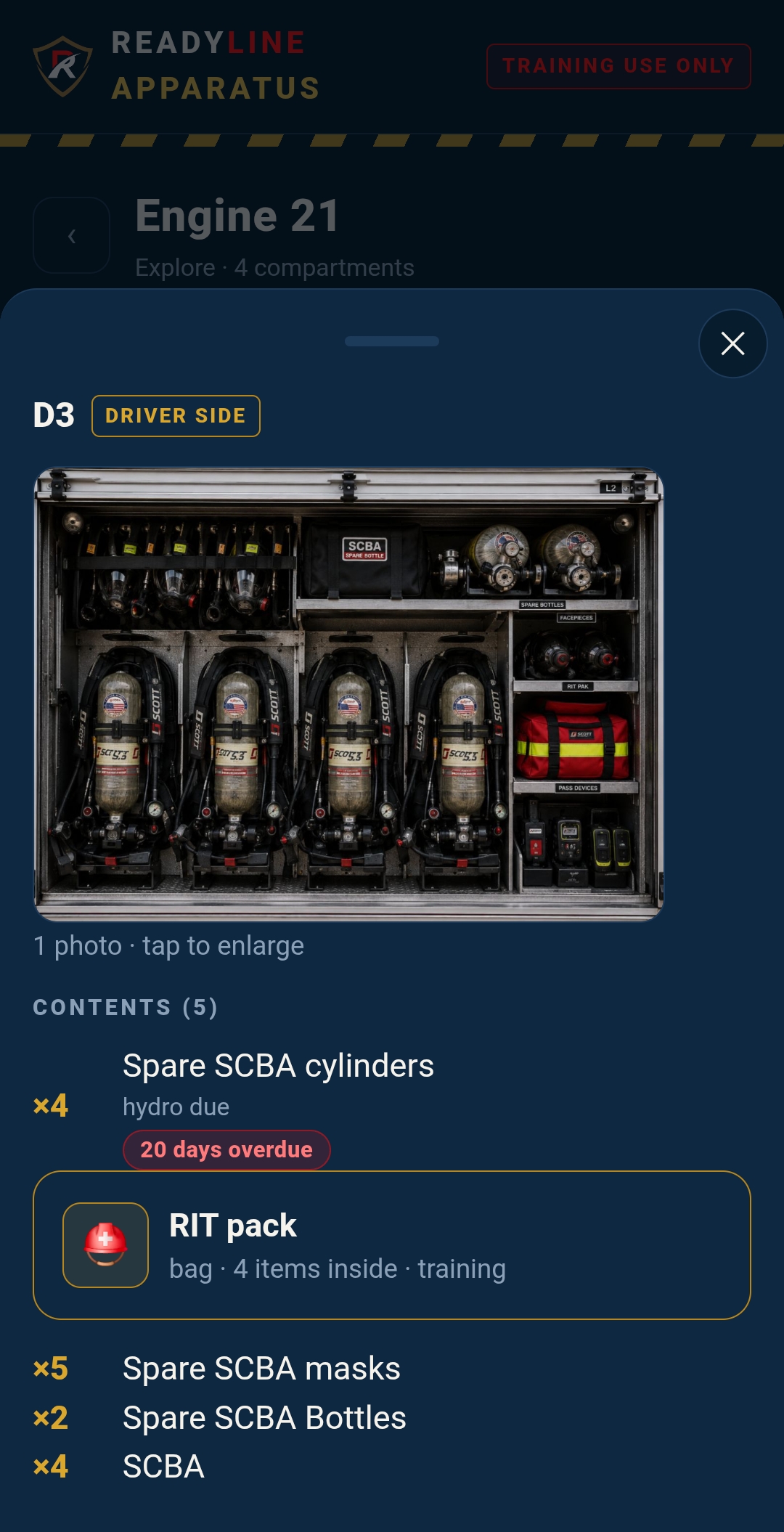
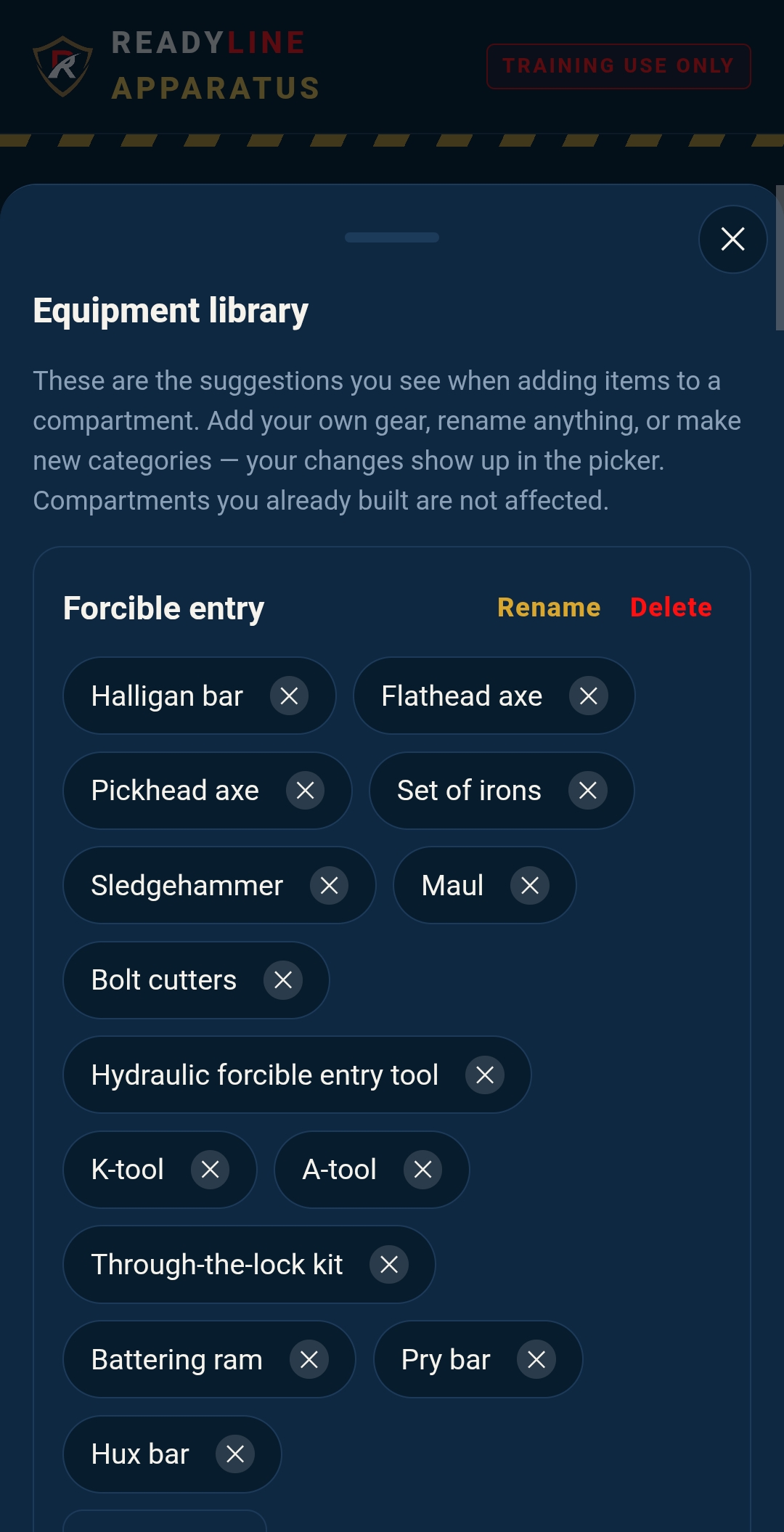
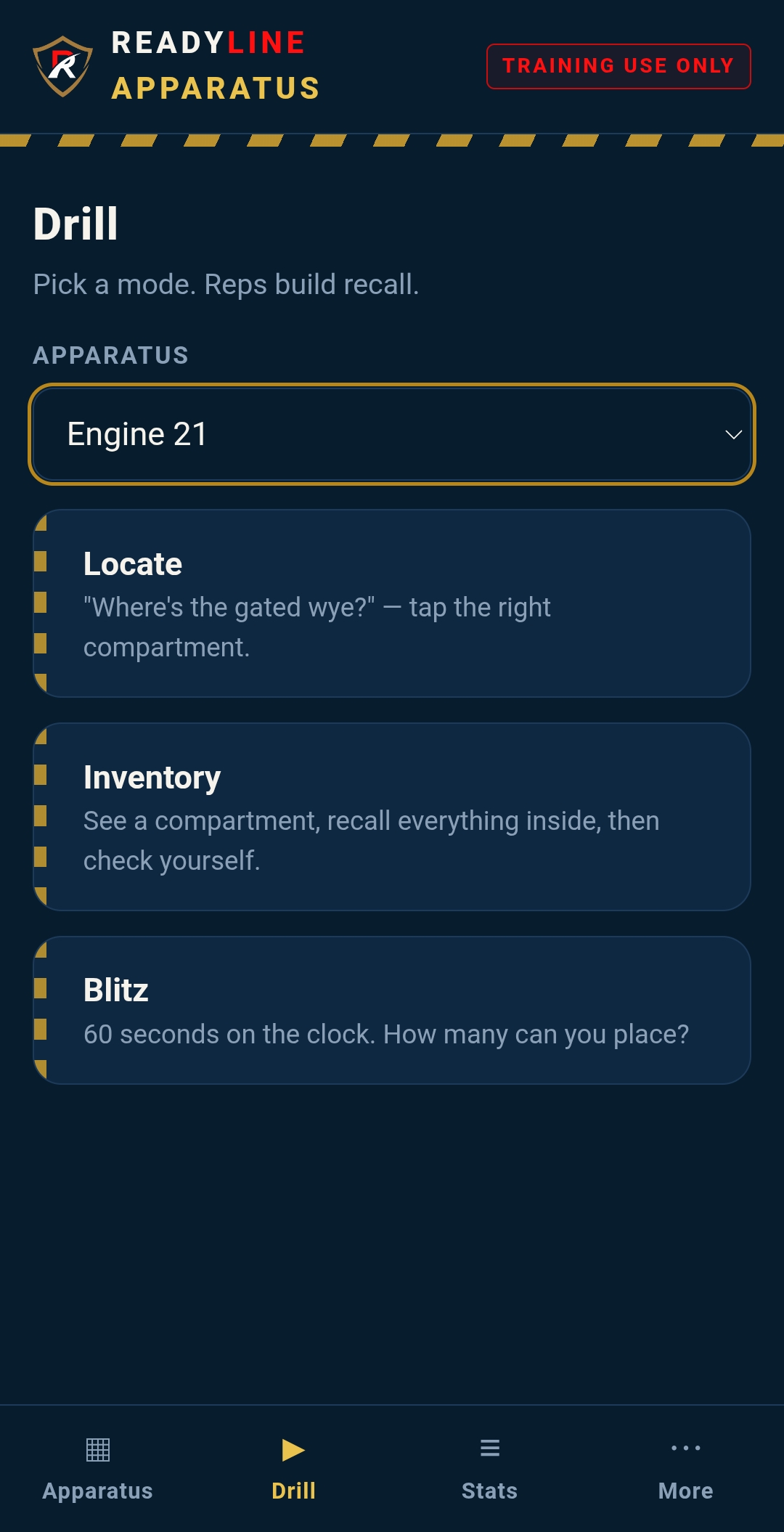
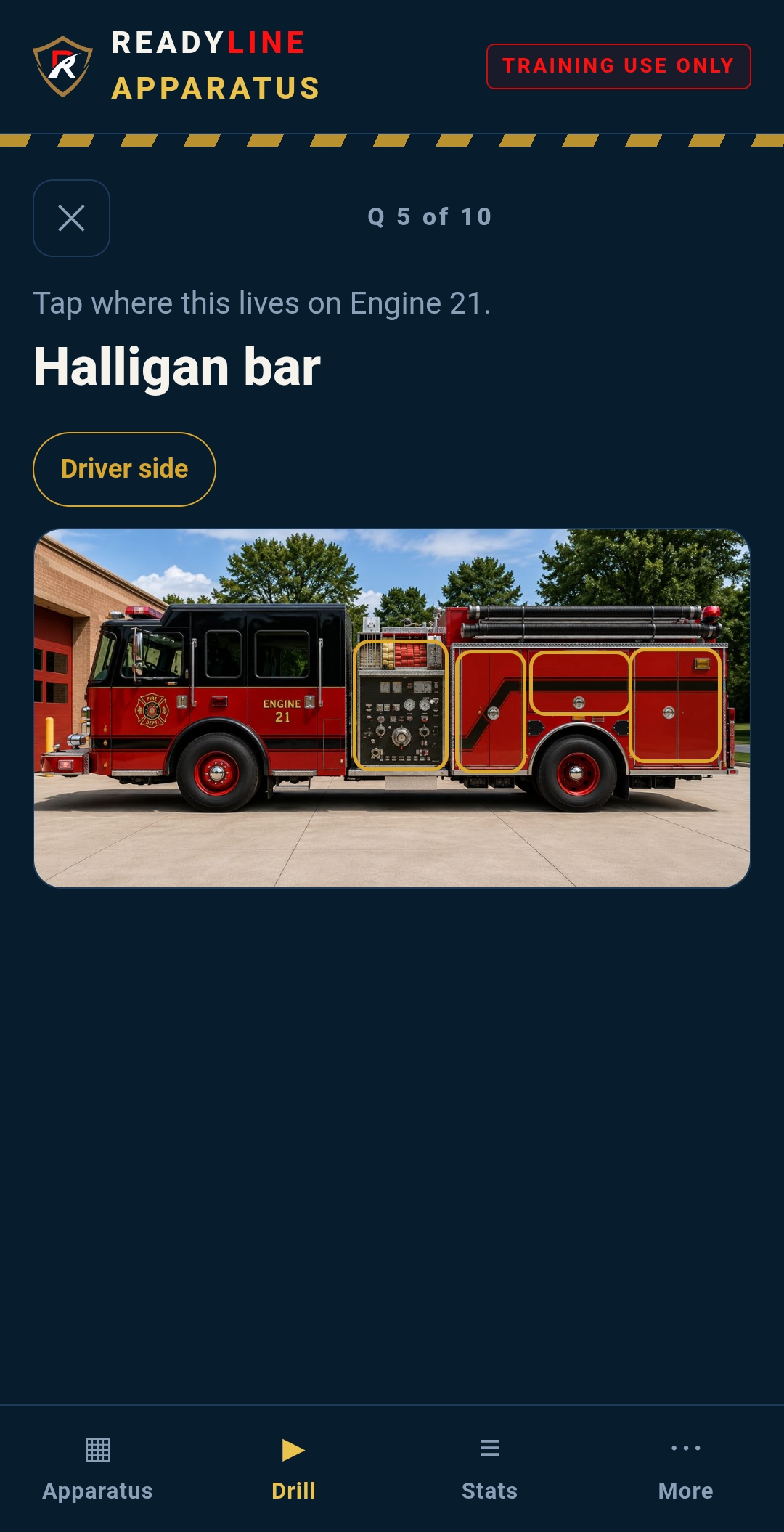
Everything lives on your phone. Photos are stored as compact images right on the device - hundreds fit without slowing things down. Nothing is uploaded, nothing leaves your hands. Back it up to a file anytime, or move it to a new phone.
ReadyLine Apparatus is a study tool, and only that. It is not an inventory system, an apparatus-check or daily rig-check record, or a reference for incident operations. It builds recall so the knowledge is already in your head when you need it - it does not replace your department's official checks or records.
Start knowing your apparatus.
Stop guessing on the fireground. Put the reps in on your own time.
Now on Google Play and the App Store - $4.99, one time. Runs entirely on your device.
Who builds this
A one-person company, run out of Michigan, by someone still working the job.
- Captain / ParamedicCareer fire service, Michigan
- Hazmat TechnicianTeam leader responsibilities
- MBAHealth Care Management
- Fire Staff & CommandFire officer command program
Built by a working firefighter, for the fire service.
ReadyLine exists for a simple reason: some of the tools worth having in the fire service just weren't there yet. There was no real way to rehearse a promotional oral board - often the part that decides it. Learning a new apparatus meant standing at the open compartments until it stuck. The idea was to build the kind of tools that fit how firefighters actually train and work.
Every ReadyLine product is developed independently, on personal time, and refined the honest way - put to real use, kept when it works, reworked when it doesn't. The aim is straightforward: practical tools, built by someone who understands the work, that help firefighters get better at it.
ReadyLine Response Solutions LLC is a Michigan limited liability company. It is independent, self-funded, and not affiliated with, endorsed by, or acting on behalf of any fire department or public agency.
Guided by firefighters, not a roadmap.
Feedback from a working officer beats a feature request every time. If a tool doesn't earn its place in the front seat, it gets cut.
Say what it isn't.
Every ReadyLine product tells you plainly what it does not do. Being honest about a tool's limits is how you build something firefighters can trust.
Priced like a tool.
Straightforward pricing, no surprises. Nothing renews on its own - you're always the one deciding what to buy and when.
Get in touch
Department walkthroughs, early access, or just a question - it comes straight to the founder.